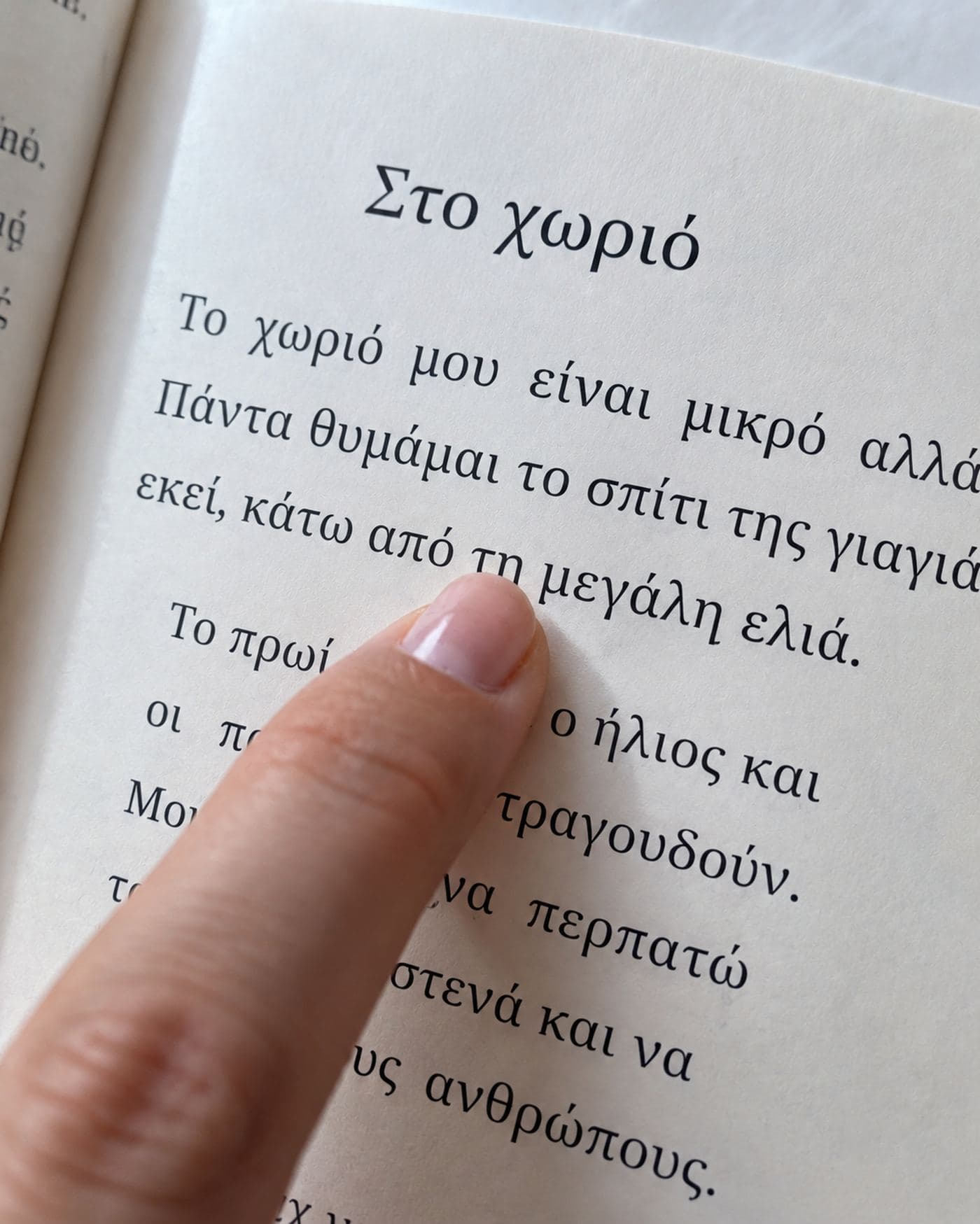
Reading Greek is a different skill from speaking it
A child who answers yiayia in Greek can still struggle to read a short sentence. Speaking and reading grow at different speeds, and reading only improves with practice. A child starting Greek from scratch has to build both at once.
Pick a level by what your child understands, not by age
Age does not map onto reading level. A ten-year-old new to Greek reads at the bottom of the scale, and a six-year-old who hears Greek every day may read a little higher. The first test is the letters. If your child is still learning the sounds of the Greek letters, start at L0. If they can read the letters but know very little Greek, start at A0. After that, the test is simple: your child should know most of the words on the page and be able to guess the rest. If they stall on every line, the level is too high, so go down one step.
Ellinica’s levels start at L0, for a reader still learning the sounds of the Greek letters, and run up to C1. A0 is for a reader who can read the letters but knows very little. See the reading levels from L0 to C1 with an example passage for each.
Not sure where to start? Try the quick level check with your child beside you.
Learn the letters first if your child has not met them
The Greek alphabet has 24 letters. If your child has not met them yet, start there before any story.
- The Greek alphabet guide: every letter with a word, a picture and its sound.
- Free printables: the alphabet, letter pairs and numbers to print. No account needed.
How to read together
Five to ten minutes is enough. These steps keep the first weeks easy.
- Let your child choose the topic. A story about their dog or their football team gets read. A story on a topic you picked often does not get opened.
- Play the story aloud first, then read it together. Ellinica reads each story aloud.
- Tap a word your child does not know to see its meaning, then carry on. Do not stop to translate every line.
- Keep each session to five or ten minutes. A little every day is worth more than a lot once a week.
- Read the story yourself first. Ellinica generates original stories at the level and topic you choose, so read a new one before you hand a child the screen.
Three tools a parent can use together
These work at every level, so they suit a first story as well as a later one.
- Read aloud. Ellinica reads the story to your child, so they hear the words before they read them.
- Word by word. This is a tick box in the reader. It says each word and waits half a second before the next, so your child can follow along with a finger. It is not a slower voice.
- Record yourself reading this. Under each paragraph, your child reads it aloud and sees which words need work. It is a monthly allowance on the Basic, Pro and Family plans, and it is not part of the free first month.
Questions parents ask
- What level should my child start at?
- Ask first about the letters. If your child is still learning the sounds of the Greek letters, start at L0. If they can read them but know very little Greek, start at A0. For a child who speaks Greek at home, try A1 and move down a step if they stall.
- My child speaks Greek but cannot read it. Is that normal?
- Yes. Speaking and reading are separate skills, and reading needs its own practice. Short stories at a low level are a gentle way to begin.
- Are the stories written for children?
- They are written for a reading level and a topic, not for an age. Choose a low level and a topic your child likes, and read a new story yourself first.
- How long should a session be?
- Five to ten minutes a day is enough to build the habit. Stop while your child still wants more.
Try one story at a low level
Pick a level and a topic your child likes. Free to start, no credit card.
Start reading free